Monday, 2 February 2015

Data, Collections & Lists: Weave Week Three

My final week was very productive and as I have noticed in previous rotations, I have found the third week to be the most enjoyable.

I wanted to develop my collection of samples further, moving on from the wool looms I began creating woven samples using thinner yarns.

Throughout my samples I wanted to clearly reference my colour palette, I decided to incorporate stronger blocks of colour in these particular samples as it shows I have thought carefully about the development in working with the different yarn qualities. One of the most important weave structures I have focused on is honeycomb, I will carry on developing my honeycomb structure incorporating the diamond structure for a juxtaposition.
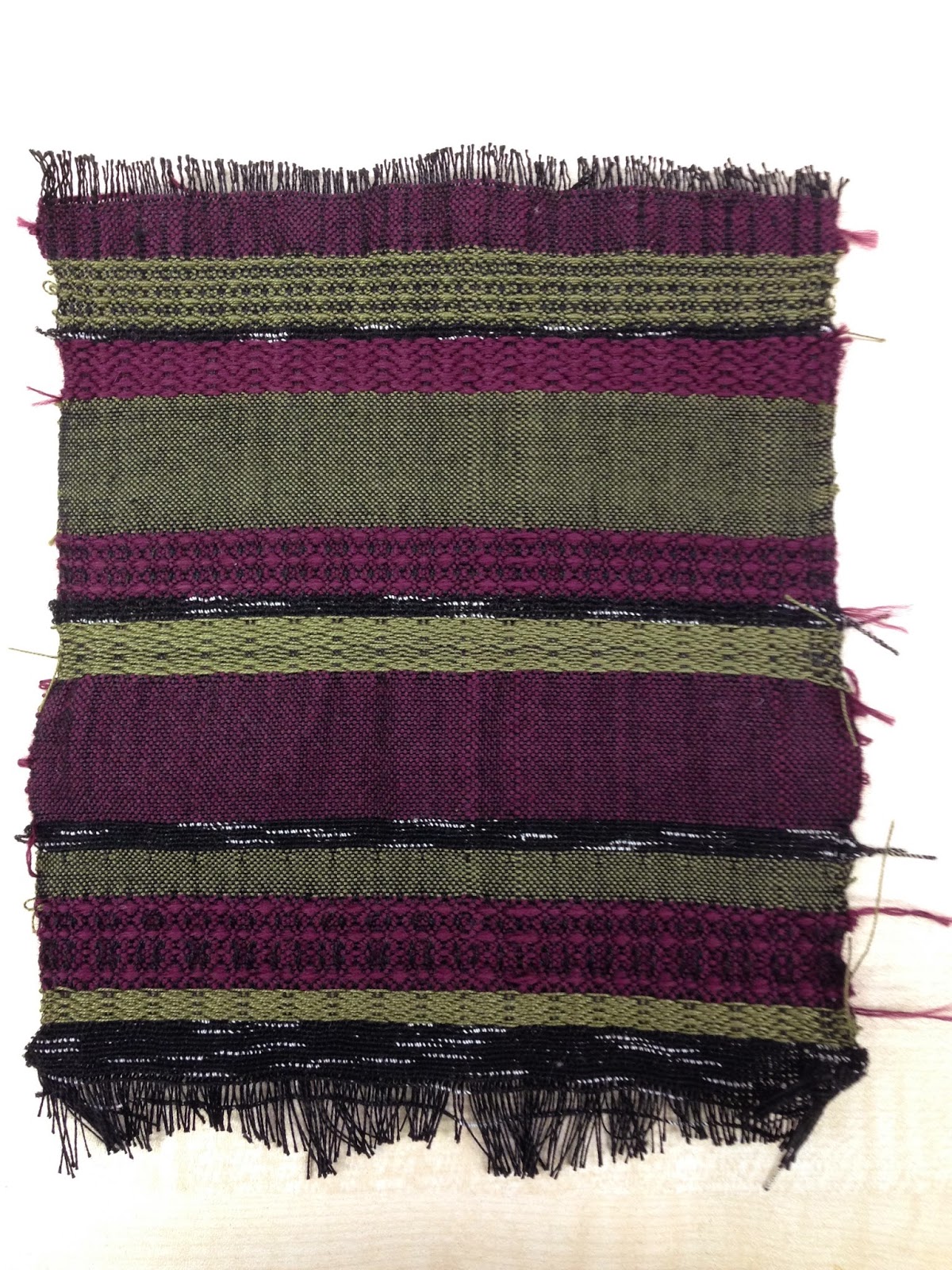
(developing samples by incorporating
block colours)

Thinking out of the box, I began trapping materials to reference my initial inspiration being photographs of crystals taken at the Manchester Museum.
(woven sample of trapping
and creating a textural surface)
Trapping foils, weaving with silver transparent paper and embedding yarns to create ruffles are some of the ways I showed the crystalised influence from initial research.

(woven sample created using
block colours)
Weave has been an inspiring three week rotation, I feel that throughout the three weeks my understanding of colour has improved. I have created woven samples which reflect strongly to each other and the colour palette behind my initial research has been expressed.

Data, Collections & Lists: Weave Week Two


During this week, I was determined to focus on creating final samples in which would reflect not only my colour pallete but also the technique I had chose to work with more in depth.

I spent the majority of the week working on the wool loom, I was really interested in working with these particular yarns because I was intrigued as to what the sample would look like after the wool had been washed.

Incorporating ribbon, selection of yarns and also elastic, I managed to create two wool woven samples in which I then washed with hot water and a little bit of shampoo to create my overall samples.

(woven wool sample incorporating elastic
and ribbon)

(second wool woven sample
on the loom in progress)
 

(detailed close up of the honeycomb
woven technique using a range of
yarns)
 
I personally preferred my woven samples before they had been washed because of the fact they shrunk massively due to the quality of the yarns I had chose to work with. However, even though my samples shrunk, the overall technique of the honeycomb was a lot more effective after being washed.
Particularly in the samples below, the elastic joined the honeycomb together more and this resulted in the samples having a lot more texture.

(final result of woven wool sample
after being washed)
 

(final result of woven wool sample
after being washed)
 
I didn't find the Friday Drawing very useful at all for the second week however, I hope it will come in handy when considering a new colour palette for the next three weeks when I specialise.


Wednesday, 28 January 2015

Data, Collections & Lists: Weave

Weave has been one of the rotations in which I have looked forward to the most, I really enjoyed the first week sampling in this area. At the beginning of the week, I was left feeling slightly confused as to working out the number sequences however, as soon as I began making samples on the looms my confusion was no longer there.

The first week of weaving was focusing on sampling with the different sequences, working on the eight shaft weaves, I followed the structures to create patterns, incorporating different thicknesses of yarns meant I could experiment with textures and the weave qualities.

First week weaving sample
on the wool looms
 
I personally felt confident that I had grasped the initial weaving concept and so I began to sample further creating samples on the wooly loom.
Throughout the first week, I focused on reflecting back to my research to collate a strong defining colour palette, I found that making yarn wrappings really helped me to define my palette.

Friday, 23 January 2015

Inspirational visit to London

During the Christmas Break, I visited the Capital City, London. The day consisted of collecting resources and finding both planned and unplanned inspiration.

Following on from my initial research to the 'Data, Collections and & Lists' brief, I visited Selfridges, Anthropologie, Liberty of London and The Tate Modern where I captured a number of photographs and made sketches providing an influence to the next three week rotation-Weave.

Entrance to Liberty of London,
Regent Street
 
Selfridges Christmas Window Display,
Oxford Road

Selfridges Christmas Window Display,
Oxford Road

The Selfridges window display and Liberty of London department store was the main influence to my new colour palette. Choosing deep blue, turquoise, gold, pink and greens will result in me having a lot to work with when making my weave samples. I look forward to incorporating my previous crystalisation of shapes and my new colour palette within weave.

Sunday, 18 January 2015

Sampling & Drawings through Embroidery

After collecting visual research from a wide range of resources, I was able to initially begin the Sampling unit 'Data, Collections & Lists' creating sketches within the Manchester Museum was the initial starting point for my produced samples. I focused on producing structural sketches through making marks which reflected the crystalisation and 3D forms of the subject.

At the start of Embroidery I hadnt thought of a context for designing, however during the second week I was drawn to creating expressive samples which had an interior art feel to them.

The majority of my sampling was influenced by the visit to Manchester Museum where I found a large collection of interesting crystals and rock forms. After drawing these crystals in their natural context, I realised that my drawings expressed an interest into collecting the detail and structural lines within the object.

Paula Kovarik was an artist whom provided inspiration for my initial samples, her work is very structural in the way she overlays materials to produce 3D structures. As crystals/rock forms are the initial resource for my embroidery samples, I chose to work with dissolvable fabric. In relation to my research, I wanted to create defining structural shapes through using the free-machine foot on dissolable fabric as the result would be a juxtaposition of structure through the stitch and then the obvious dissolving inbetween the stitch.

After the first week of embroidery sampling, I felt that I could develop and provide stronger connections from my drawings. Whilst keeping Kovarik in mind as contextual reference, I began exploring with a range of materials, using transparent papers as the main focal point. The transparent paper worked really effective within my sample, I was able to be expressive with my stitch to produce linear and structural outcomes.

Throughout the Embroidery rotation, I found Friday Drawing Day influencial within my samples. The task of mark-making was extremely beneficial, having to produce mark making sketches within a timed schedule meant that I had to work with a very free and expressive mindset. When sampling, I had focused alot of the time on thinking about what to create instead of actually just trial and erroring however, after this drawing task I personally feel my samples became alot more expressive and influencial to crustal forms.

I was getting more confident through sampling in embroidery, however, I felt that some of my samples were quite similiar and I wanted to develop these whilst still holding onto the sucessful elements. I had briefly looked at textile artist Carolyn Saxby’s mixed media work as contextual research,to develop my samples further I began working in a similar way to Saxbys. I began cutting up the samples in which I thought were less successful, collaging them together using brown cardboard, yarns and transparent paper. These samples were very different to my first two weeks of embroidery as within my third week samples, negative space became more expressive. The juxtaposition of the detailed collaged sampling and the negative space helped to create more of a focus to the detail and less of the background.

Overall, throughout embroidery I feel that my initial drawings have referenced and been influential for not only my sampling but for the overall thought and design process.

Friday, 19 December 2014

Week Three Sampling Unit; Embroidery

Week Three has been a very busy and productive week for myself.

Hand stitch has been introduced through many of my samples this week, in particular the French knot. I feel like I have been able to create strong textured samples whilst incorporating certain hand stitch techniques.

Paula Kovarik is a textile designer that has strongly influenced my second/third week development of samples. She has created beautiful textural fabric pieces by juxtaposing both a simple running stitch with a stiff ruffled choice of fabric. Taken from her beautiful textiles I have been inspired to incorporate wadding, silk, metallic foils andtransparent paper, whilst incorporating french knots and a simple straight stitch. My samples have been able to develop through detail and influence transparency.

Being able to reflect over my 6-8 made samples over the last few weeks has really helped with my development through embroidery and I feel that I have progressed massively since the first week.

Friday Drawing Day was extremely helpful, using black and white media we responded to the words we heard, making marks on paper surfaces to create beautiful textured mark making outcomes. I went home and researched mark making further as I really enjoyed how abstract the surfaces could be. Laura Phan is one artist I am going to further my experimenting through samples as I am hoping to produce similar mark making samples through stitch and fabric over the Christmas period.

Week Two Sampling Unit; Embroidery

Looking back over my second week studying embroidery, it is clear that I have struggled to get to grips and truly understand what the concept of embroidery is and also the direction I should be working in.

After the first week of embroidery I felt fairly confident that I was on the right path in terms of developing my samples etc, however on Tuesday we had a 1-1 with Kate and a number of comments she made suggested that she was looking for a slightly different approach than to the samples I had created.

It was suggested that I chose a specific collection of imagery from the Museum to be of influence, and when I look over my week one samples I understand that they are far too literal with the research.

I chose to use this week to really push myself and create samples in which strongly addressed an influence to textures which meant manipulating materials and combining both hand and machine stitch to suggest an influence from my visual research of the crystals and rocks.

Thursday was when my sampling began to develop, in particular focusing on the choice of silk fabric and materials I created movement through stitch. I spent a couple of hours free machining stitches onto dissolvable fabric however, unfortunately when I washed the dissolvable fabric away the stitches did not stay as defined as I had hoped.

I will develop these samples into week three by incorporating light weight fabrics with hand stitching embellishments.